New medical diploma launches to support Syria’s future health workforce
28 June 2026
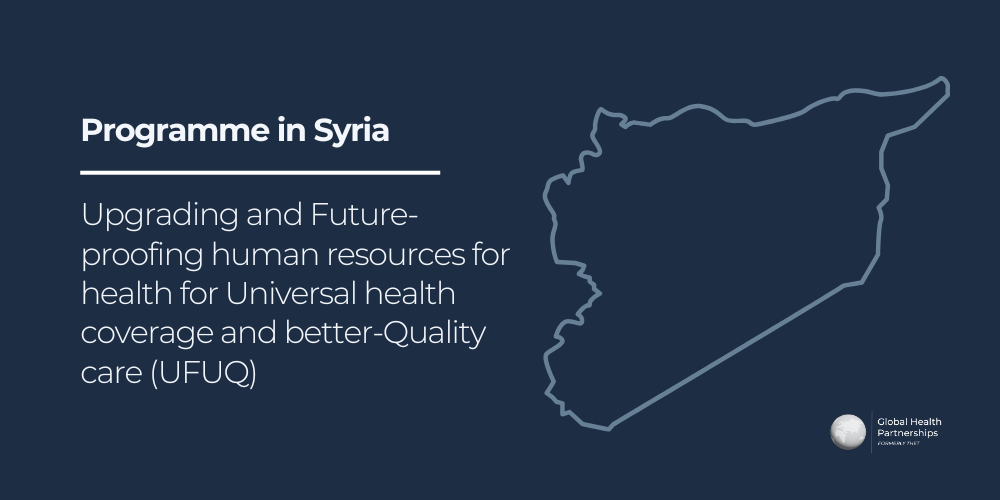
50 Syrian doctors have been selected for a new programme designed to strengthen postgraduate medical education and help rebuild specialist training across the country
Global Health Partnerships (formerly THET), with funding from the European Union and in partnership with Union of Medical Care and Relief Organizations (UOSSM), has launched a new Professional Diploma in Postgraduate Medical Education (PGME) in Syria.
The diploma is part of the Upgrading and Future-proofing human resources for health for Universal health coverage and better-Quality care (UFUQ) programme. The programme aims to support Syria’s health workforce and help ensure people across the country can access good quality healthcare long into the future.
Launching on 27 June 2026, the new diploma marks an important step in strengthening medical leadership and specialist training in Syria.
Building future medical leaders
Delivered by the Arab Institute for Continuing Professional Development (AICPD)and accredited by the Syrian Board, the 18-month hybrid learning programme will support 50 Syrian medical professionals to become future leaders in postgraduate medical training.
The selected cohort included specialists and senior residents working in accredited teaching facilities or those with documented supervisory roles. They were chosen through a competitive process, with 90 applications received for 50 places.
Over the next 18 months, participants will learn how to design, revise and manage postgraduate training programmes in 4 critical specialities: Emergency Medicine, Obstetrics and Gynaecology, Anaesthesia and Psychiatry.
Strengthening specialist training
Participants will also work together to develop national accreditation standards, design speciality- specific curricula and improve training systems. The aim is not only to train individual doctors but also to help build the foundations for a stronger, more sustainable postgraduate medical education system in Syria.
Dr. Muhammad Al-Khatib, General Director of the Syrian Commission for Medical Specialties, The Syrian Board, said the diploma comes at a critical moment for the country:
“Today, Syria is undergoing a critical and pivotal phase in its modern history, where all national efforts are focused on rebuilding state institutions on the foundations of efficiency, transparency and international best practice.
At the heart of this institutional renaissance, reforming and advancing postgraduate medical education is essential to rebuilding the healthcare sector and ensuring the quality of care provided to our people.
The launch of the Medical Education Diploma represents a strategic and bold step toward institutionalising and localising medical expertise in the future of Syria.
Our objective extends beyond equipping doctors with clinical skills. We aim to foster a new educational mindset by empowering 50 doctors, including specialists and senior residents, to become the leadership nucleus and the first generation qualified to develop modern medical curricula and manage training programmes in line with the highest global standards.”
Designed around Syria’s needs
The programme has been designed to respond directly to needs identified in Syria’s health system. Preparatory work included hospital assessments to identify suitable training centres, the development of a tailored job description for the programme and the selection of academic faculty to ensure the course combines theory with practical relevance.
Ahmed Mbayed, Country Representative for Global Health Partnerships (GHP) in Syria said the programme has been developed in close collaboration with the Syrian Board:
“The launch of this diploma today is the fruit of a close, extended and collaborative partnership with the leadership of the Syrian Commission for Medical Specialities (The Syrian Board), who have demonstrated an exceptional commitment to sustainable future development.
We are deeply heartened by the enthusiasm and interest from Syrian medical professionals. The programme received 90 applications from highly motivated specialists and senior residents, from which 50 physicians were carefully selected to join this specialised cohort.
This diploma was not built in isolation. It was developed through rigorous field-level work and joint planning with the Syrian Board, including comprehensive hospital assessment and selection of medical faculty to ensure the programme meets the real needs of the healthcare sector.”
Supporting long-term change
The ambition is to ensure the diploma can be sustained locally in the long term.
Ahmed Mbayed said:
Our ultimate goal goes beyond delivering a temporary training programme. We are committed to localising this diploma and transferring technical and managerial expertise to the Syrian Board’s teams. We want to empower the Board to independently design and manage future diplomas and curricula, enabling it to produce its own future leaders in medical education for generations to come.
This milestone would not have been possible without the close cooperation and support of the Ministry of Health, our strategic partnership with the Syrian Board and the generous funding of the European Union. We remain firmly committed to continuing this shared journey toward building a resilient and sustainable healthcare sector in Syria.”
As teaching begins, the new cohort will work on one of the most important challenges facing Syria’s health system – ensuring the country can continue to train the specialists it needs.
By strengthening postgraduate medical education, the diploma will support stronger healthcare institutions, better prepared medical leaders and ultimately improved care for patients across Syria.



0 Comments
Leave a comment
Your email address will not be published.