GHP celebrates milestone as WHO updates Global Code on health worker recruitment for first time in sixteen years
26 May 2026
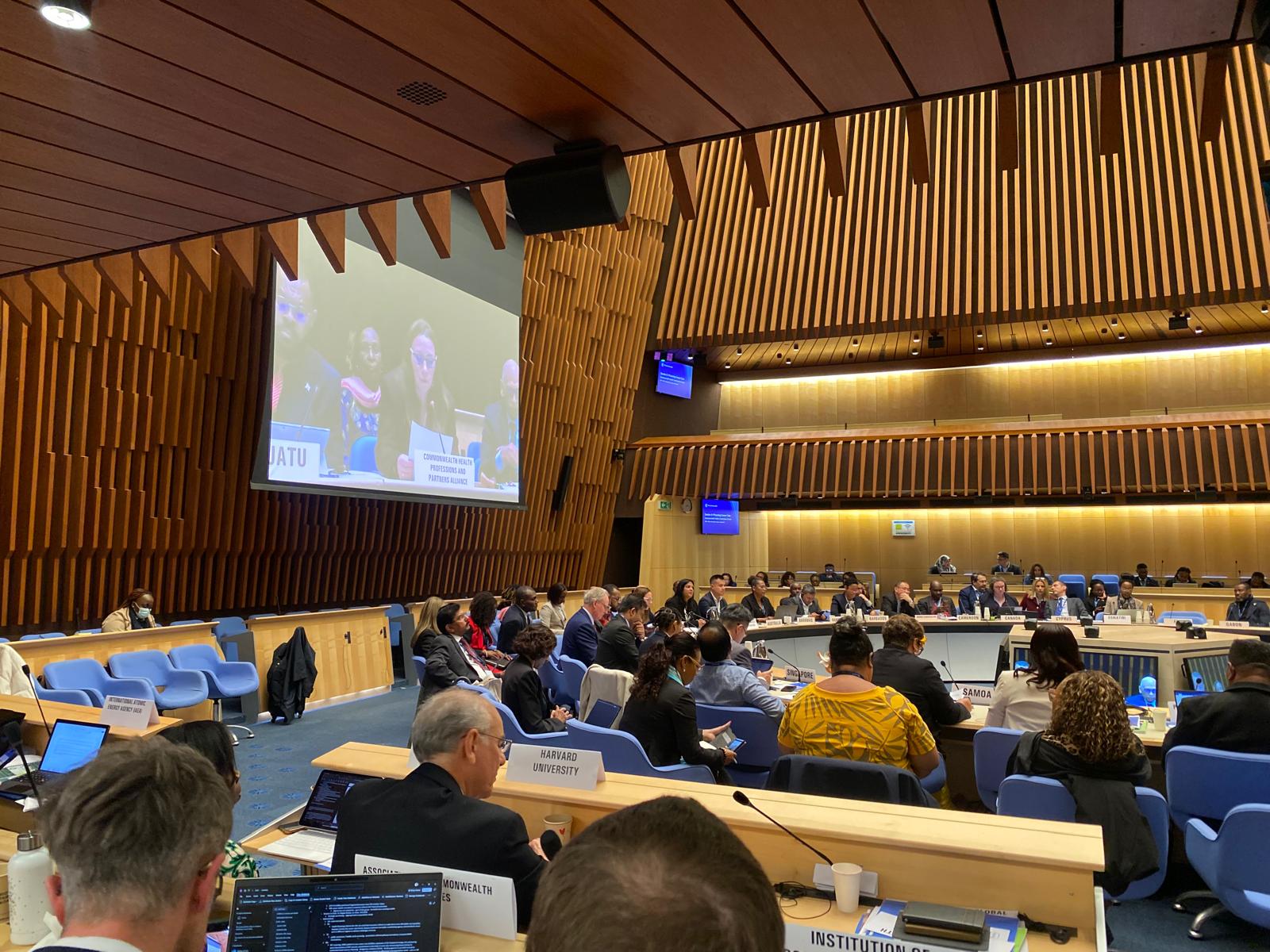
Global Health Partnerships (GHP) has welcomed the adoption of updated recommendations to the WHO Global Code of Practice on the International Recruitment of Health Personnel at the 79th World Health Assembly — the first revision to the Code in sixteen years — following three years of sustained advocacy and policy work in which the organisation played a central role.
The Expert Advisory Group appointed to review the Code found that high-income destination countries were making substantial savings on health worker training costs through international recruitment while promised investments in source country health systems had not materialised to yield the expected proportional benefits. The updated resolution urges destination countries to establish “mutually agreed, structured, measurable and transparent co-investment arrangements to deliver proportional benefits” in source country health systems and workforce development — with skills partnerships named explicitly as the lead example of how this should work.
For GHP, that language carries particular weight. The organisation has been designing, funding and evidencing precisely this model — NHS institutions paired with health system counterparts in low- and middle-income countries, operating across education, clinical practice, management and retention — in close partnership with successive UK governments since 2008. The Code revision represents, in a meaningful sense, the international policy framework catching up with what GHP and its NHS partners have been demonstrating on the ground for nearly two decades.
The revised Code also extends to care workers for the first time, closing a loophole wealthy ageing societies had used to staff elder care with workers trained in lower-income countries. It applies universally during pandemics, emergencies and humanitarian crises — ending the principle that ethical recruitment is a fair-weather commitment. And Annex 5 calls for co-investment “across the entire health worker life cycle — education, employment and retention” — language that reflects directly the whole-system approach GHP has consistently advocated.
GHP’s Technical Director Margaret Caffrey served as lead author of the APPG report An Honest Account of the Benefits and Costs of International Health Worker Recruitment, chaired by Sir Andrew Mitchell MP, which provided the evidentiary foundation for the co-investment argument. The report calculated that the UK had saved an estimated £14 billion in averted training costs through international recruitment, with up to £1.1 billion in 2024–25 alone. GHP Trustee Titilola Banjoko served on the WHO Expert Advisory Group that shaped the revised recommendations, and Jim Campbell — who drove the Code review process as WHO’s Director of Workforce — has joined the GHP Board.
Speaking at a side event co-organised by GHP, the Centre for Global Development, the World Bank, OECD and IOM on the margins of the Assembly, GHP CEO Ben Simms said: “There is no health without a health worker. We have spent too long talking about aid and charity. What this report does — and what the revised Code begins to do — is tell the truth about who benefits in a world where international recruitment is structural, not incidental.”
Albert Domingo, Secretary and Chief of Staff at the Philippines Department of Health, told the event: “We must move from transactional recruitment to genuine partnerships — one where you can look each other in the eye and say this is an honest accounting.”
GHP’s engagement on this agenda stretches back to the 5th Global Forum on Human Resources for Health in Geneva in 2023, where CEO Ben Simms first publicly called for a global financing mechanism for health workforce and named the subsidy flowing from low- to high-income countries through international recruitment. At WHA77 in 2024, GHP — then operating as THET — co-hosted a side event with the Philippines Government and WHO on sustainable health workforce management, with Moses Mulimira, GHP’s Diaspora Engagement Advisor, foregrounding the role of diaspora health workers as experts connecting the NHS to over 200 health systems worldwide.
The Health Partnership model the Code now formally endorses has been sustained in the UK largely through official development assistance. GHP has noted that the model is proven — but that sustaining and scaling it to meet the ambition of the revised Code requires precisely the co-investment flows that destination countries are now being called upon to deliver.
GHP’s domestic diaspora programme, Experts in Our Midst, continues to advance the complementary argument that internationally recruited NHS staff should be recognised as asset-holders — experts in two health systems simultaneously — rather than as beneficiaries. A joint GHP–DHSC Diaspora Advisory Committee, approved in 2025, provides a formal mechanism for translating that work into Departmental policy.



0 Comments
Leave a comment
Your email address will not be published.