Managing the Global Movement of Health Workers: Toward Ethical and Sustainable Solutions
14 May 2026
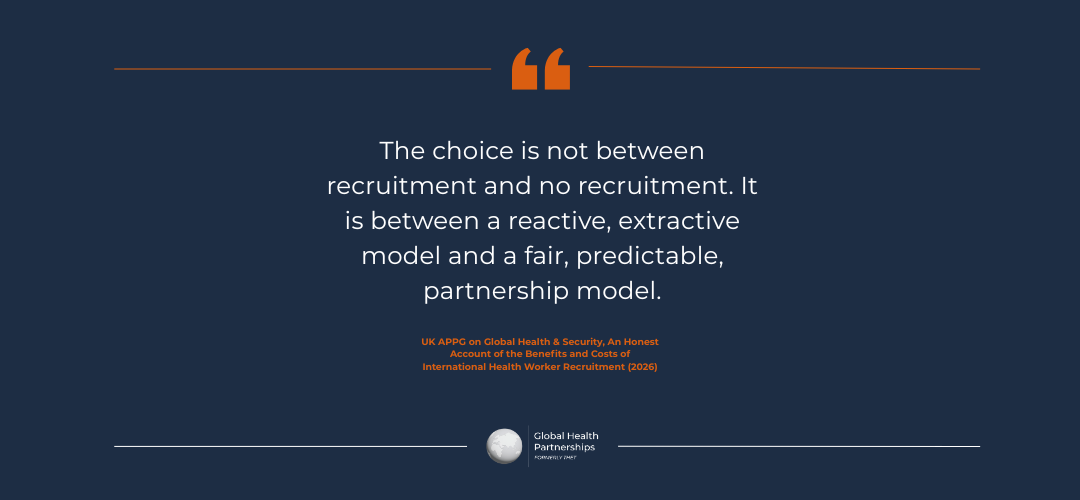
With the Global Code of Practice on the International Recruitment of Health Personnel is underreview, a high-level side event at the seventy-ninth World Health Assembly will convene governments, multilateral institutions and health workforce experts to move from diagnosis to delivery.
The international mobility of health workers is accelerating and its consequences are deeply uneven. Countries of destination, including the UK, Canada, and the United States, benefit enormously from the skills and dedication of internationally educated doctors, nurses, and allied health professionals. But many of the countries those health workers leave behind – predominantly low- and middle-income nations – face increasing workforce shortages, weakened health systems, and growing barriers to universal health coverage.
Compounding this is a “paradoxical surplus”: qualified health workers in many source countries cannot find employment at home, even as their colleagues are recruited abroad – exposing weak labour markets and chronic underinvestment in domestic health systems.
Momentum is building. At the 79th World Health Assembly, Member States will consider amendments to strengthen the Global Code of Practice. Alongside this, the APPG on Global Health and Security’s latest report – ‘An honest account of the benefits and costs of international health worker recruitment’, puts hard numbers on what high-income countries gain from internationally trained health workers. Together they build a stronger case for proportionate co-investment – a fairer compact built on mutual benefit between the countries that educate and train health workers and those that employ them.
This creates a timely opportunity to move beyond diagnosis and toward practical solutions.
About the Event
- When: 20 May 2026, on the sidelines of the WHA79
- Where: Geneva, Switzerland
- Co-hosted by: Center for Global Development, World Bank, OECD, International Organization for Migration (IOM), and Global Health Partnerships (GHP)
- Format: Expert panel and policy discussion
Discussions will span a range of practical options: ethical recruitment frameworks, bilateral arrangements between source and destination countries, and innovative financing and partnership mechanisms. Crucially, the event will also address the political dimension – how to build the will and mobilise leadership among destination countries to commit to proportionate co-investment.
Speakers
Welcome Remarks
Ben Simms
Chief Executive, Global Health Partnerships
Contributors
Margaret Caffrey
Technical Director, Health Systems — Global Health Partnerships
Manjula Luthria
Senior Economist, Social Protection Labor and Jobs — World Bank
Albert Domingo
Undersecretary and Chief of Staff, Department of Health — Philippines
Khassoum Diallo
Unit Head, Health Workforce — World Health Organization
Giorgio Cometto
Team Lead, Human Resources for Health Policies — World Health Organization
Panellists
Agya Mahat
Technical Officer, Health Workforce — World Health Organization
Elizabeth Warn
Head, Labour Mobility Division — International Organization for Migration
Jim Campbell
Professor of Practice in Health Workforce — King’s College London
Fatima Kyari
Registrar/CEO, Medical and Dental Council of Nigeria
Dr Ouma Oluga
Principal Secretary for Medical Services, Ministry of Health — Kenya
Additional speakers to be confirmed.
Moderator
Helen Dempster
Policy Fellow & Co-Director, Migration and Displacement Programme — Center for Global Development
Closing Remarks
Jean-Christophe Dumont
Head, International Migration Division — OECD



0 Comments
Leave a comment
Your email address will not be published.