Breast cancer stories from Uganda and Zambia
22 October 2026
Case study 1: Uganda
He thought breast cancer only affected women
How a radio talk show and a village medical camp helped a man in south-western Uganda access a breast cancer diagnosis and treatment
In 2022, a man in Ntungamo District, in south-western Uganda, noticed a small swelling in his left breast. We will call him Jerome, although that is not his real name. He was in his early forties, and like many people he believed breast cancer was something that happened to women. Because he was a man, the possibility never crossed his mind, so he did what many people do when they have a worry they cannot explain. He turned to herbalists.
For two years he went from one herbalist to the next, even travelling deep into villages in neighbouring Isingiro District in search of stronger medicine. The swelling grew to the size of a fist, and the skin began to break down. A local health centre dressed the wound and treated it as an infection, but the real cause went unrecognised.
Then, in December 2025, Jerome heard a radio talk show announcing that health workers from the Uganda Cancer Institute would hold a medical camp close to his home. The camp was organised by Global Health Partnerships with funding from Sanofi, as part of the A Focus on Breast Cancer project, which uses radio programmes and outreach to reach people in places health services rarely visit. At the camp, a health talk explained that breast cancer affects men as well as women. As he listened, Jerome realised that this might be what was happening to him.
By then he was in severe pain and could not move without support. Dr Kafero, a senior surgeon on the team, examined him and arranged for him to be referred to Mbarara Regional Cancer Centre for a biopsy and further care. He was diagnosed with advanced breast cancer and is now receiving treatment.
Dinavence Kebirungi, Master Trainer and Senior Health Educator, Uganda Cancer Institute
Jerome’s experience highlights why early breast cancer awareness matters. Through the ‘A Focus on Breast Cancer’ programme, outreach activities have reached communities across 14 districts in the Mbarara and Arua regions. The programme also trained 249 primary health workers and 611 community health workers, and distributed information materials in local languages to help more people recognise possible signs of breast cancer and seek appropriate care.
Case study 2: Zambia and the United Kingdom
Learning across borders to strengthen breast cancer care
What a Zambian oncologist brought home from Birmingham and shared with colleagues
Breast cancer is one of the most common cancers among women in Zambia, yet most cases are found late. Patients often face fragmented care, and many are lost between their first clinic visit and the start of treatment. The project’s Master Trainers, the senior clinicians who train other health workers, are at the centre of the response, which means that strengthening their expertise strengthens everything that follows.
Dr George Pupwe is one of them. A consultant and Head of the Department of Radiation and Clinical Oncology at the Cancer Diseases Hospital in Lusaka, he travelled to the United Kingdom in May 2025 for the Association of Breast Surgery’s Global Health Symposium and Annual Conference in Birmingham. He then spent three weeks at University Hospitals Birmingham, hosted by consultant breast surgeon Mr Naren Basu.
Each day he shadowed teams across breast clinics, radiology, and the chemotherapy and radiotherapy units. What stayed with him most were the multidisciplinary team meetings, where oncologists, surgeons, radiologists, pathologists and nurse navigators sit down together and plan each patient’s care. He also saw nurse navigators guiding patients through every step so that no one falls through the gaps, and one-stop breast clinics where screening, imaging and biopsy happen in a single visit.
Back in Lusaka, Dr Pupwe did not try to copy what he had seen. He adapted it. He has advocated for more regular, structured team meetings at the Cancer Diseases Hospital and started discussions about a simple patient navigation model to track referrals and follow-up. He has also shared standardised clinical breast examination protocols and basic risk assessment tools with fellow Master Trainers, and he continues to mentor primary health workers during supervision visits in Lusaka.
Dr Songiso, Levy Mwanawasa University Teaching Hospital, and Dr George Pupwe, Cancer Diseases Hospital
One placement has become learning for a whole network. What Dr Pupwe saw in Birmingham now reaches patients in Lusaka, and health workers across Zambia, through the cascade of training that Sanofi, the Association of Breast Surgery and Blended Learning UK help to support.
Case study 3: Zambia
Making breast cancer education accessible to all
How health workers in Lusaka used touch and sound to make breast cancer education accessible to people with visual impairments
Most breast health education relies on posters on a clinic wall, leaflets and visual demonstrations. Without accessible alternatives, people who are blind or have low vision may miss out on information about breast cancer and how to seek help when they notice changes.
In June 2026, trained health workers from Chilenje Level 1 Hospital in Lusaka set out to change that. Working with the Zambia Library for the Blind, they ran two sessions designed around touch and sound. The team explained the risk factors and warning signs of breast cancer and why a monthly self-check matters. Then they taught self-breast examination on anatomical models, giving clear step-by-step spoken instructions and helping each person one to one, so that everyone could feel the technique for themselves.
Report on the screening demonstration, Chilenje Level 1 Hospital
Forty-eight people took part: 31 men, 10 women and 7 adolescents. Every one of them completed the hands-on practice, and people said they felt more confident to check themselves at home each month. More men than women came, a reminder that men are keen to learn and that breast cancer affects them too. One participant who needed further assessment went to Chilenje Level 1 Hospital and is being followed up. The team also reached 101 people at the hospital’s outpatient department on 8 June, bringing the total to 149 over three days.
Participants asked for more regular sessions and accessible resources, such as audio and braille materials. The team plans to continue the work through quarterly sessions at the library and training for visually impaired peer educators who could help lead future activities. As the project approaches completion, the aim is to embed more inclusive breast cancer education within the Ministry of Health’s existing health promotion work, helping to sustain this approach beyond the life of the project.
Case study 4: Zambia
Taking screening to the health posts
A weekly outreach model that is building skills in the clinics it visits
Many small health posts and health centres in Lusaka have no health worker or volunteer trained in breast cancer. For people living nearby, there is nobody to ask about a lump or a change in the skin, and nowhere close to go for a clinical breast examination.
Chipata Level 1 Hospital decided not to wait for people to come to it. It set up a deliberate weekly programme that takes breast cancer awareness sessions and clinical breast examinations to health posts and centres without trained staff. A medical doctor joins every visit to assess anyone with symptoms and refer them for further tests and care.
People responded well. More came forward for information and screening, and Dr Kennedy Kalinde from the hospital observed that more community members now come to health facilities of their own accord when they notice changes in their breasts.
Dr Thandiwe Banda, Medical Officer, Chipata Level 1 Hospital
The visits have also left something lasting behind. Because the programme worked, two health workers from the host centres were selected for the project’s primary health worker training in June 2026. Once trained, those centres will be able to carry out clinical breast examinations themselves, without waiting for the weekly visit.
Outreach brings breast cancer awareness and examinations closer to communities today, while training local health workers can help sustain those services beyond the visits. By combining the two approaches, the hospital is helping build the skills needed to make breast health care more accessible through local facilities.
——–
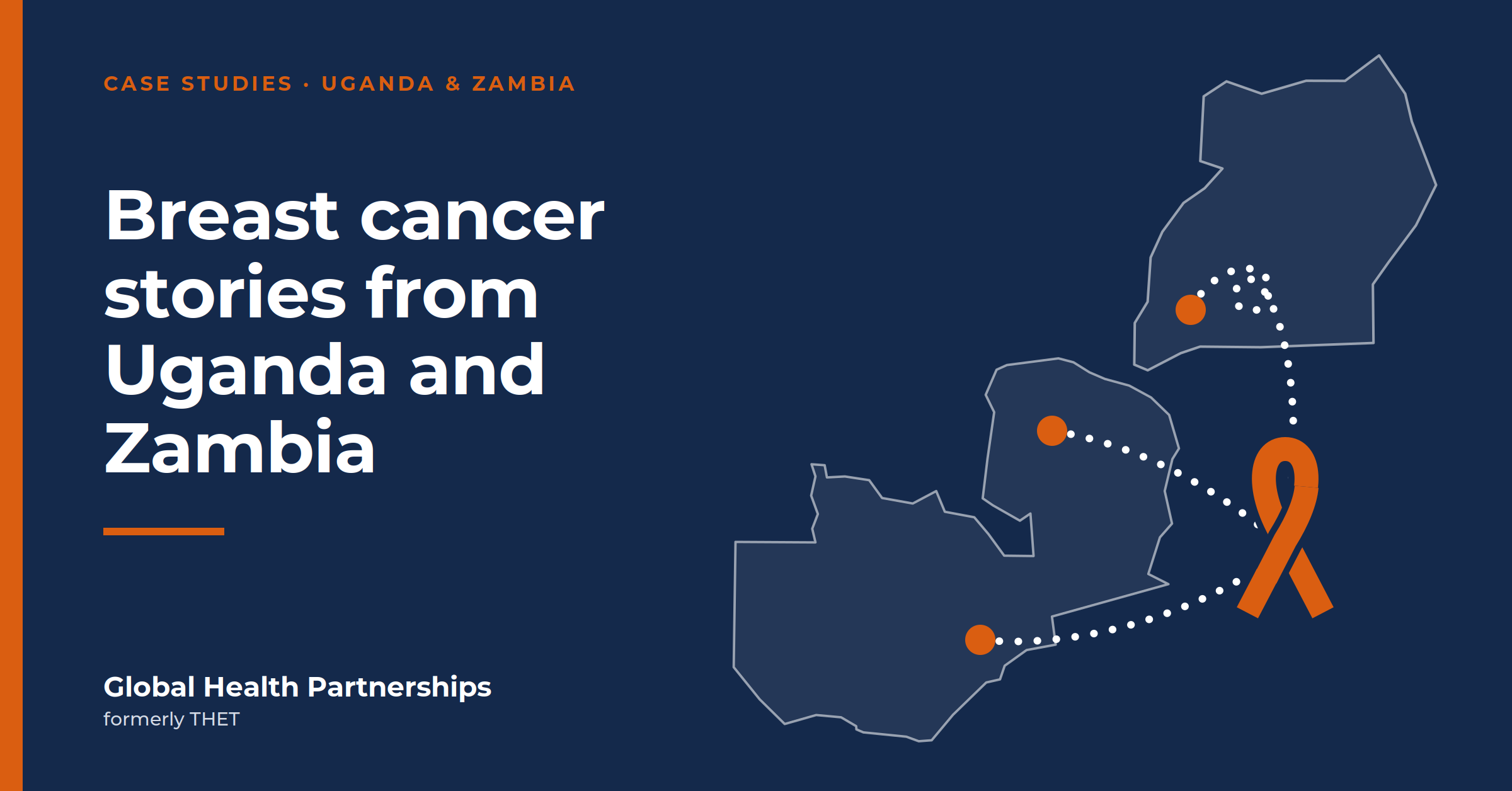
These case studies come from ‘A Focus on Breast Cancer in Zambia and Uganda’, a project delivered by Global Health Partnerships (formerly THET) and funded by Sanofi, in partnership with the Association of Breast Surgery and Blended Learning UK.


0 Comments
Leave a comment
Your email address will not be published.