What five years of conflict has meant for healthcare in Myanmar
25 February 2026
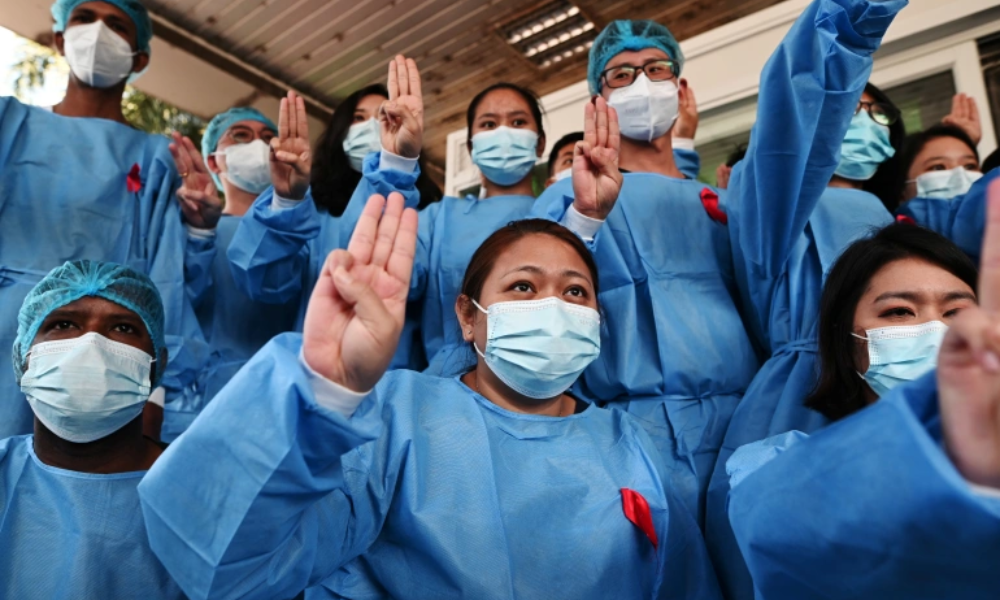
This month marks five years since Myanmar was plunged into a turmoil following the military coup of February 2021.
In that time, global attention has shifted. New crises have taken centre stage. Myanmar has largely slipped from the headlines.
But for the country’s 55 million people, the impact of the coup has not receded. It has reshaped daily life – nowhere more profoundly than in healthcare.
Hospitals have been occupied by the military. Clinics have been damaged or closed. Providing medical care outside state control has become dangerous. Many health workers have been killed, detained, forced into hiding or pushed into exile.
What has unfolded is not simply the erosion of a system under pressure, but the steady narrowing of space in which healthcare can safely exist.
Global Health Partnerships alongside Cambridge Global Health Partnerships marked the 5th Anniversary with a parliamentary meeting, hosted by Monica Harding MP which brought together a variety of global health stakeholders.
The event offered UK parliamentarians an opportunity to learn about the ongoing crisis and the persecution facing health workers in Myanmar, whilst also celebrating their resilience and bravery over the last 5 years.
The session heard how Myanmar’s health system has adapted rather than disappeared.
And of the ways in which doctors, nurses, midwives and allied health professionals have begun to reassemble it in fragments – often out of sight and at great personal risk. Parallel governance structures have been formed, working alongside Ethnic Health Organisations, together providing leadership and continuity to health service delivery.
Care is mostly delivered in displacement camps, private homes, jungle clinics and informal networks. Parallel systems operate with limited or no salaries, legal protection or formal recognition, sustained by professional duty and deep community trust.
These clinicians are not only treating illness and injury.
They are maintaining the principle that care should still be available – even when the structures meant to support are not there.
Protection in principle, not in practice
Internationally, there is no shortage of commitments to protect healthcare and the UK Government is making an important contribution to the international response.
But five years on, Myanmar shows how fragile those commitments can be.
Accountability for attacks on healthcare remains limited. Humanitarian access is constrained. And too often, the clinicians delivering care outside official systems are excluded from funding, planning and decision-making.
The result is not just absence from the news cycle, but a quieter form of neglect – within the very systems designed to offer protection.
What solidarity looks like when systems fall short
Against this backdrop, parts of the UK health community have shown what practical solidarity can mean.
Through and alongside Global Health Partnerships (formerly THET), NHS clinicians and partners have supported training, telemedicine, nursing and medical education, advocacy and wellbeing – working alongside Myanmar health workers when formal channels were no longer available.
These partnerships have not replaced Myanmar’s health system.
They have helped sustain it – offering professional connection, skills and support to clinicians working under extraordinary constraints.
Why five years still matters
Protecting health workers goes beyond statements of principle.
It requires long-term diplomatic engagement, accountability for attacks on healthcare and recognition of clinicians working outside formal systems.
Myanmar shows what is at stake when those protections are fragile or uneven.
Five years on, Myanmar’s health workers are still standing.
It is time for the international community to stand alongside them.



0 Comments
Leave a comment
Your email address will not be published.