What Kyiv taught Manchester
14 October 2026
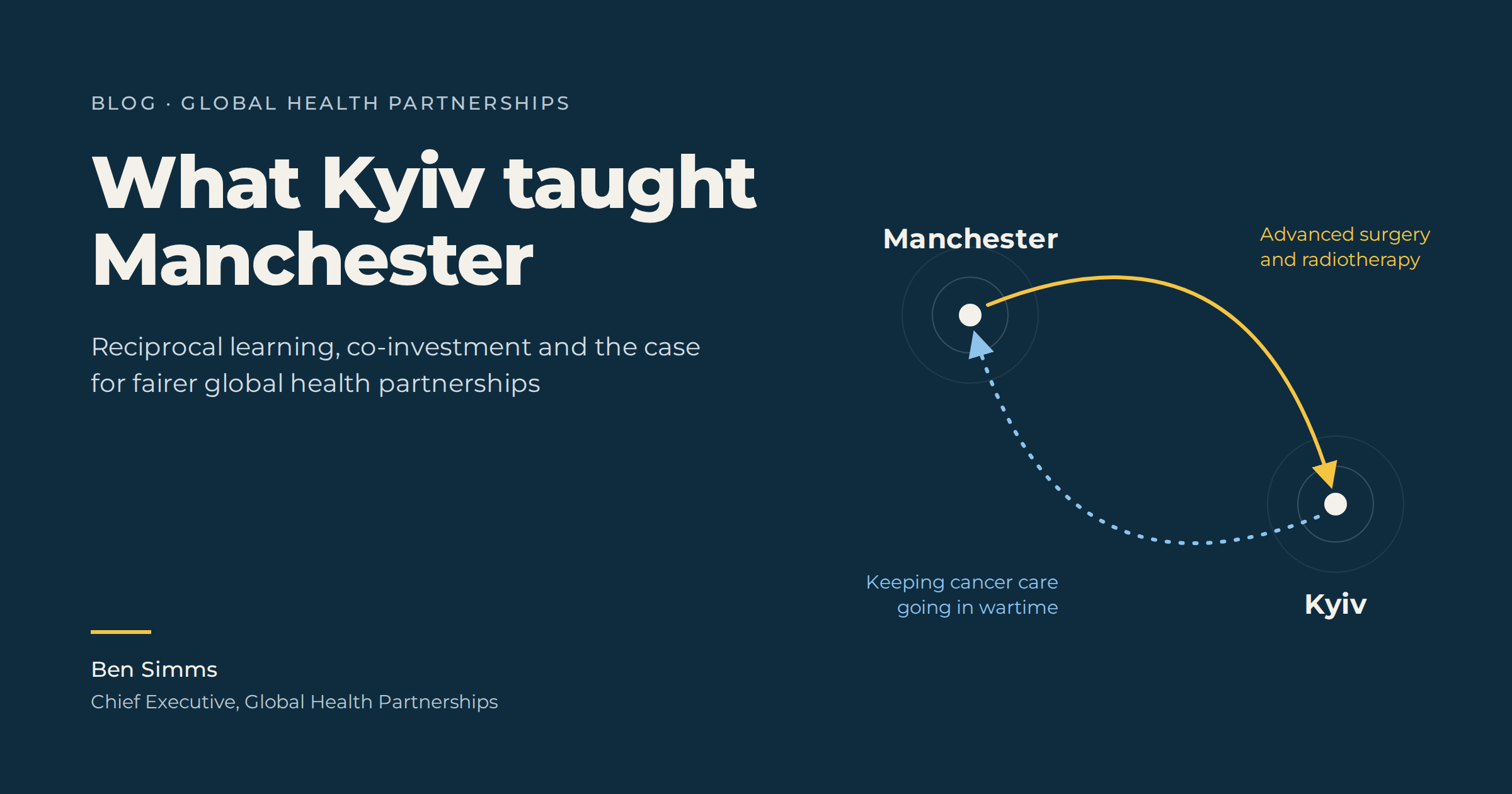
Earlier this year, a group of cancer specialists from the National Cancer Institute of Ukraine finished a training placement at The Christie in Manchester. At the end, they stood up and presented what they had learned.
They had come to train in advanced surgery and radiotherapy at Europe’s largest single-site cancer centre. Their talks also covered something their hosts had never had to do: treat cancer in a country at war. They described radiotherapy services disrupted by attacks and patients whose routes to treatment had been cut by occupation and missile strikes. They described how their teams kept care going anyway.
Even in wartime, they told the room, cancer does not stop.
The Christie’s clinicians were learning too. One later described the project as bilateral learning, “as any partnership should be”. Manchester shared new techniques with Kyiv. Kyiv showed Manchester how a cancer service adapts and stays efficient, under pressure few NHS teams have faced.
That partnership, funded through Global Health Partnerships, is one of the examples in a paper “The future of global health partnerships: Co-investment, reciprocal learning and mutual benefit” we published over Summer in PLOS Global Public Health with King’s College London. It sets out how the UK can lead a fairer model of global health partnership, and why the timing is right.
A Manchester story for a Manchester PM
Last month the Labour Party was in Liverpool for its annual conference, a short train ride from The Christie. Andy Burnham gave his first conference speech as Prime Minister. He was Mayor of Greater Manchester for nine years and Health Secretary before that. He will know how much the NHS in the North West relies on staff who trained overseas.
In July he said Britain should show leadership on the international stage, not retreat from it. Our paper points to a practical place to start.
An honest account
More than one in five NHS staff report a non-British nationality. A cross-party parliamentary inquiry we supported which published in March estimated that recruiting doctors, nurses and midwives trained abroad has saved the UK £14 billion in training costs.
Every one of those health workers was trained somewhere. At the UK Global Health Summit in March this year, Nigeria’s Minister of State for Health said more than half of his country’s doctors have taken concrete steps to emigrate. Each doctor who leaves represents more than $200,000 spent on their education.
Meanwhile, the money that once helped offset this is drying up. The OECD projects that aid for health will fall by 29 to 46% between 2024 and 2026.
Health workers have every right to build careers where they choose and the NHS is stronger for the people who chose the UK. But a country that gains this much from other nations’ training budgets has a stake in those budgets. Our paper argues that the UK should invest in the health systems and institutions that produce the staff it relies on, as a partner rather than a donor.
From osmosis to equilibrium
This year, three international meetings reached the same view independently.
The African–Nordic Health Summit met in Stockholm in January. The UK Global Health Summit brought more than 600 people from 28 countries to London in March. In May, the UK and South Africa co-hosted the Global Partnerships Conference. Each had a different history and a different starting point. All three concluded that the old picture of global health, in which one country gives and another receives, no longer matches how health systems work.
Dr Diana Atwine, Uganda’s Permanent Secretary for Health, summed it up at the London summit. Partnership, she said, had moved from osmosis, where everything flows one way, to equilibrium, where “everyone has something to bring on board”.
The World Health Organization has moved in the same direction. In May, member states adopted a revised Global Code of Practice on the international recruitment of health workers, the first update in sixteen years. It gives new weight to shared investment and skills partnerships between the countries that train health workers and the countries that employ them.
The UK has a head start
The UK is not starting from scratch. The Government has funded our health partnerships without a break since 2008. Through the Global Health Workforce Programme, more than 600 UK health workers have volunteered overseas, helping to train and support some 30,000 health workers across six countries, in line with each country’s own workforce priorities.
The NHS gains from this work too. Staff who take part build skills and experience they bring back to their own teams. The Christie’s clinicians did it without leaving Manchester.
A seat at the head of the table
In December the UK takes over the presidency of the G20 from the United States. It chairs the G7 in 2028. Ministers have told Parliament they will set out their G20 priorities after the Miami summit in December and that the work to decide them is already under way.
That makes the next few weeks important. The UK has spent decades building the evidence for partnerships that work in both directions. The G20 gives it a platform to persuade other countries that recruit health workers to do the same.
Our paper asks the Government to put fair health partnership on that agenda: co-investment in the systems that train health workers, long-term links between institutions like The Christie and the National Cancer Institute of Ukraine and a lead role in bringing other recruiting countries with it.
Jim Campbell, my co-author at King’s College London, puts it simply: “Health workers cross borders and the benefits cross borders with them. Investment should do the same.”
Read the full paper in PLOS Global Public Health


0 Comments
Leave a comment
Your email address will not be published.